

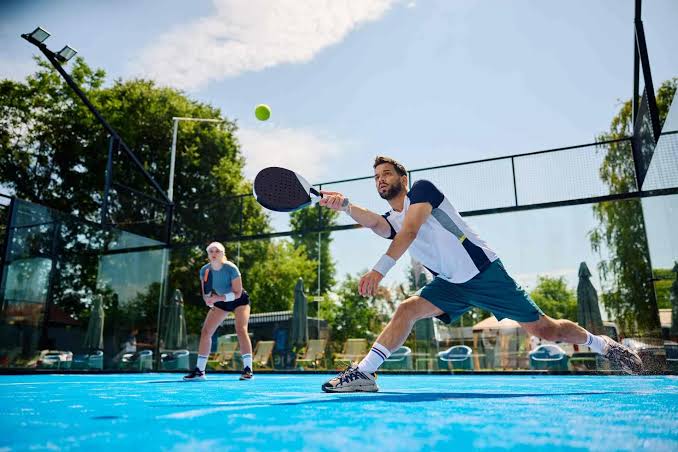
Padel tennis is one of the fastest-growing racket sports in the world. It combines elements of tennis and squash, creating a game that is easy to learn but challenging to master. Players use solid rackets, play on an enclosed court and can use the glass walls to keep rallies alive.
The sport has attracted beginners, experienced tennis players and professional athletes. Its social format and simple basic rules make it suitable for people of different ages and abilities.
Padel is also expanding rapidly across international markets. The International Padel Federation (FIP) reported more than 40 million players worldwide in its 2026 World Padel Report. The same report recorded 91,234 courts across 191 countries and independent territories.
Published on 14 October 2026, the report also highlighted the sport’s economic impact, estimating that the global padel industry generates €8.6 billion in GDP.
But what exactly is padel tennis, how do you play it, and why has it become so popular? Here is a complete guide to its rules, court dimensions, equipment and growing appeal.
What Is Padel Tennis?
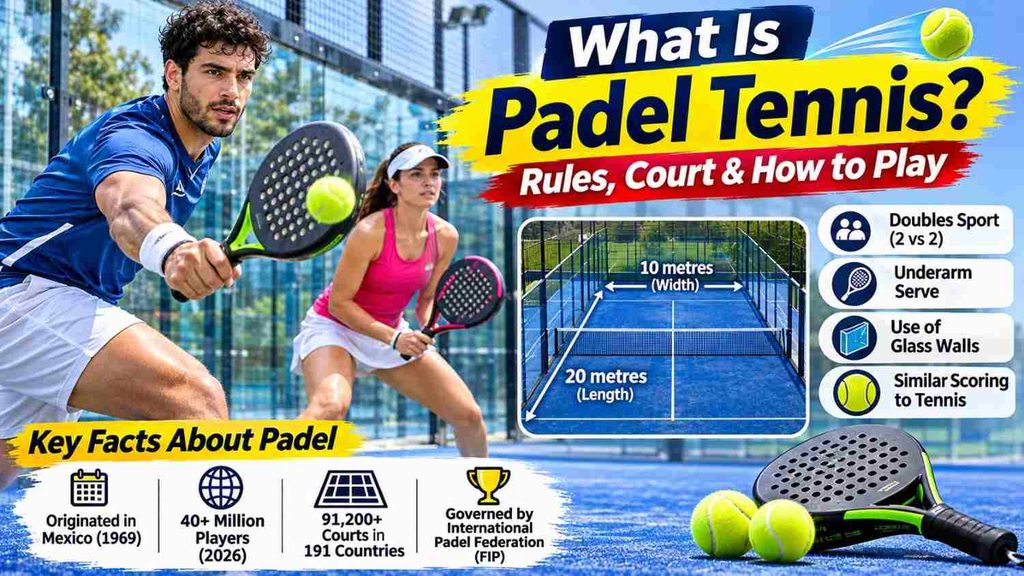
Padel is a racket sport usually played between two teams of two players. It takes place on a smaller enclosed court surrounded by glass walls and metal fencing.
The scoring system is similar to traditional tennis. However, the way players serve and use the court is different. Players serve underarm, and the ball can bounce off the glass walls during a rally.
A padel racket has no strings. It is a solid, perforated racket with a short handle. The ball looks similar to a tennis ball but has lower pressure.
The main aim is to hit the ball over the net and make it bounce inside the opponents’ court. Players can use the walls strategically to return difficult shots or create awkward angles.
Padel is mainly a doubles sport. The smaller court encourages teamwork, communication and quick reactions.
History of Padel Tennis: Where Did It Start?
Padel originated in Mexico in 1969. Mexican businessman Enrique Corcuera built an enclosed court at his home in Acapulco. The limited space and surrounding walls influenced the design of the game.
The sport later reached Spain through Alfonso de Hohenlohe, who introduced padel courts at a club in Marbella during the 1970s. It gradually became popular in Spain and Argentina before spreading to other countries.
The International Padel Federation was established in 1991 to help organise and develop the sport internationally. Today, it oversees international competitions and works with national federations to promote padel.
Its growth has turned the sport into a major part of the international racket sports scene.
Padel Tennis Court: Dimensions and Layout
A standard padel court measures 20 metres long and 10 metres wide. It is smaller than a traditional doubles tennis court and has an enclosed playing area.
The court is divided into two halves by a net. Each half contains service boxes marked by service lines.
Glass walls and metal fencing surround the playing area. These surfaces are not simply boundaries. They are part of the game and allow players to return the ball after it rebounds.
Standard Padel Court Dimensions
| Court Feature | Standard Measurement |
| Court Length | 20 metres |
| Court Width | 10 metres |
| Net Length | 10 metres |
| Net Height at Centre | 0.88 metres |
| Net Height at Ends | 0.92 metres |
| End-wall Enclosure | 4 metres total, typically 3 metres of wall plus 1 metre of fencing |
The enclosed design is one of the biggest differences between padel and tennis. Players can allow the ball to rebound from their own walls before returning it.
The court is also divided into service areas. A player must serve diagonally into the opposite service box. These markings help determine whether a serve is valid.
Padel Tennis Rules: How to Play
Padel follows a straightforward scoring system, but players need to understand how serving, rebounds and walls work.
Here are the main rules beginners should know.
1. Padel Is Mainly Played in Doubles
A standard padel match has four players, with two on each team. Both partners share the court and work together to defend and attack.
Players usually position themselves on opposite sides of their half. Good communication is important because opponents can target the gaps between partners.
Some venues offer singles courts, but doubles remains the standard format in competitive padel.
2. Serving Must Be Underarm
Every point begins with an underarm serve. The server must first bounce the ball on the ground and hit it at or below waist height.
The serve must travel diagonally into the opponent’s service box. Players get two attempts, just as in tennis.
The server must keep at least one foot in contact with the ground and must not touch the service line or its imaginary centre-line extension while serving.
A serve is a fault if the ball does not land in the correct service box or hits the metal fencing after bouncing. If the ball touches the net and then lands correctly without touching the fencing, the serve is generally replayed as a let.
3. The Ball Can Bounce Off the Walls
This is the rule that makes padel different from traditional tennis.
During a rally, the ball can bounce once on the court and then hit the glass wall or metal fencing. The receiving player can still return it before it bounces for a second time.
Players can also hit the ball towards their own glass wall to send it back over the net. This creates different angles and defensive opportunities.
However, the ball must first land inside the opponent’s court before hitting their wall or fencing. If it hits the wall directly without touching the court, the shot is out.
4. Players Must Return the Ball Before a Second Bounce
A team loses the point if the ball bounces twice on its side before a player returns it.
Players can hit the ball before it bounces, which is known as a volley. However, they cannot volley the serve return. The receiving player must allow the serve to bounce first.
5. Players Can Play Shots Outside the Court
Some padel courts have doors and designated areas for play outside the enclosure. In competitions where these facilities and rules apply, players can run outside to return a ball that has left the court.
This creates exciting rallies and requires quick movement.
6. Players Cannot Touch the Net
A player loses the point if they or their racket touch the net while the ball is in play. Players must also avoid touching the ball with their body or clothing.
Padel Tennis Scoring System
Padel uses the same traditional scoring sequence as tennis. Points progress from 0 to 15, 30 and 40. A team must win four points with a two-point advantage to take a game.
If both teams reach 40, the score becomes deuce. Under the traditional advantage scoring system, a team must win two consecutive points to win the game.
A set is normally won by the first team to reach six games with a lead of at least two games. If the score reaches six games all, a tie-break is generally played.
Professional and recreational matches commonly use a best-of-three-sets format. Competition regulations can also provide alternative scoring formats, so players should check the rules for their event.
The Star Point Scoring System in 2026
The Star Point scoring system is a new deuce format included in the FIP Rules of Padel for the 2026 season. The FIP General Assembly unanimously approved the rule change on 28 November 2025. The revised rules became effective on 1 January 2026.
Under this format, teams can play up to two advantage cycles after deuce. If neither team wins the game during those cycles, a final deciding point called the Star Point determines the winner.
The system was introduced to balance traditional scoring with a quicker and more decisive finish to close games. It made its debut at FIP Bronze Melbourne on 5 January 2026. It was subsequently introduced on the Premier Padel circuit at the Riyadh Season P1 in February 2026.
The system is also used on the CUPRA FIP Tour, FIP Promises and FIP Beyond circuits.
Traditional Advantage and Golden Point formats remain recognised options under FIP rules. The scoring format used depends on the competition regulations.
Padel Scoring at a Glance
| Score | Meaning |
| 0 | Love |
| 15 | First point |
| 30 | Second point |
| 40 | Third point |
| Deuce | Both teams have 40 |
| Advantage | One point ahead after deuce |
| Star Point | Final deciding point under the Star Point format |
| Game | Won by securing the required points and advantage |
Padel vs Tennis: What Are the Main Differences?
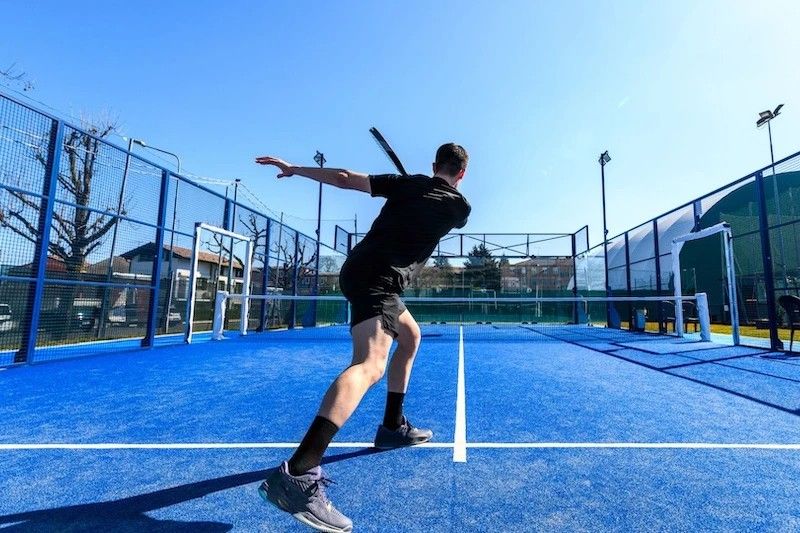
Source Image: Padelmagazine
Padel and tennis share a similar scoring system, but they are different sports. The court, racket, serve and use of walls change how players approach each game.
| Feature | Padel | Tennis |
| Standard Format | Doubles | Singles and doubles |
| Court Size | 20m × 10m | 23.77m × 10.97m for doubles |
| Racket | Solid racket without strings | Racket with strings |
| Serve | Underarm | Usually overarm; underarm serves are also permitted |
| Walls | Used during rallies | Not part of normal play |
| Ball | Lower pressure than a standard tennis ball | Standard tennis ball |
| Scoring | Tennis-style scoring, with approved alternatives | Tennis scoring |
| Playing Style | Teamwork and controlled angles | Power, movement and court coverage |
Padel generally feels more accessible to beginners because the court is smaller and the underarm serve is easier to learn. The walls also give players another chance to return the ball.
Tennis often requires greater court coverage, especially in singles. It also places more emphasis on serving technique and powerful groundstrokes.
Neither sport is automatically easier for everyone. Both require practice, movement and good shot selection.
Why Is Padel Tennis Becoming So Popular?
Padel’s rapid growth is supported by its social format, accessible rules and expanding court network.
The FIP World Padel Report 2026, published on 14 October 2026, provides a clear picture of this expansion. It recorded more than 40 million players worldwide, 91,234 courts and a presence in 191 countries and independent territories.
Some additional figures from the report highlight the sport’s growing influence:
- €8.6 billion: Estimated contribution to global GDP.
- 20.4%: Year-on-year growth in the number of courts.
- 47%: Share of players who are women.
Here are some reasons behind the sport’s popularity.
1. Easy for Beginners to Learn
New players can understand the basic rules quickly. The underarm serve and smaller court make it easier to start playing without advanced tennis skills.
Players can learn through regular games and improve their technique over time.
2. A Social Team Sport
Padel is mainly played in doubles. Players spend the match communicating, planning shots and supporting their partners.
This makes it an attractive activity for friends, families and workplace groups.
3. Longer and More Engaging Rallies
The walls keep the ball in play after it rebounds. Players can recover from difficult positions and continue rallies that might end quickly in tennis.
This creates more opportunities for tactical shots and teamwork.
4. Growing Court Availability
More clubs and sports facilities are investing in padel courts. The FIP reported 91,234 courts worldwide in 2026, representing 20.4% year-on-year growth.
The report’s figures indicate that a new court is being added roughly every 36 minutes on average. As facilities become easier to access, more people can try the sport.
5. Professional Competitions Are Expanding
Padel is no longer limited to recreational players. Professional tournaments attract international athletes and growing audiences.
The FIP supports international competition through its circuits, including Premier Padel and the CUPRA FIP Tour. These events give players opportunities to compete at different levels.
Equipment Needed to Play Padel
Beginners do not need a large collection of equipment. A few basic items are enough to start.
- Padel racket: Choose a solid racket with a comfortable grip. Beginners often benefit from a round racket because it offers a larger sweet spot and easier control.
- Padel balls: Use balls designed for padel. They look similar to tennis balls but generally have lower internal pressure.
- Sports shoes: Choose shoes that provide grip and support for quick sideways movements. Suitable court shoes help reduce slipping.
- Comfortable clothing: Wear lightweight sports clothing that allows free movement.
- Water bottle: Matches involve repeated movement and short bursts of activity. Staying hydrated is important.
Is Padel Tennis Suitable for Beginners?
Yes. Padel is a good option for people who want to try a racket sport without learning a complicated technique from the beginning.
The smaller court makes it easier to reach the ball. The underarm serve also reduces the technical challenge of starting a point.
Beginners should first learn how to serve, return the ball and use the walls. They should also practise communicating with their partner and moving together as a team.
It is better to focus on control and consistency before attempting powerful shots. Regular practice helps players understand the rebounds and develop better positioning.
Conclusion
Padel tennis combines the scoring style of tennis with the enclosed court and wall rebounds associated with squash. Its underarm serve, doubles format and accessible rules make it attractive to beginners and experienced racket sport players.
The sport’s international growth is also impressive. The FIP World Padel Report 2026 recorded more than 40 million players, 91,234 courts and a presence in 191 countries and independent territories. It also estimated the sport’s global GDP contribution at €8.6 billion.
Its scoring formats have evolved, with the Star Point system introduced in major FIP competitions during 2026. This gives players another option for deciding close games while retaining traditional scoring formats.
Whether you want a new fitness activity, a social game or a competitive sport, padel offers an engaging option. Its growing network of clubs and tournaments suggests that its popularity will continue to spread.
Frequently Asked Questions
No. Padel uses a smaller enclosed court, a solid racket and an underarm serve. Players can also use the glass walls during rallies. Traditional tennis uses a larger open court and a stringed racket.
A standard padel match has four players, with two players on each team. Singles padel is also possible on specially designed courts, but doubles is the usual format.
A standard padel court is 20 metres long and 10 metres wide. It has a net in the middle and glass walls and metal fencing around the playing area.
Yes. During a rally, the ball can bounce once on the court and then hit the glass wall or metal fencing. Players can also use their own walls to return the ball. However, the ball must bounce in the opponent’s court before hitting their wall.
Padel is easy to learn, social and suitable for different skill levels. Its doubles format encourages teamwork, while the enclosed court creates longer rallies. Growing investment in courts and professional competitions has also helped the sport expand worldwide.